Get in touch
Please fill in the form and we will get back to you with your request.
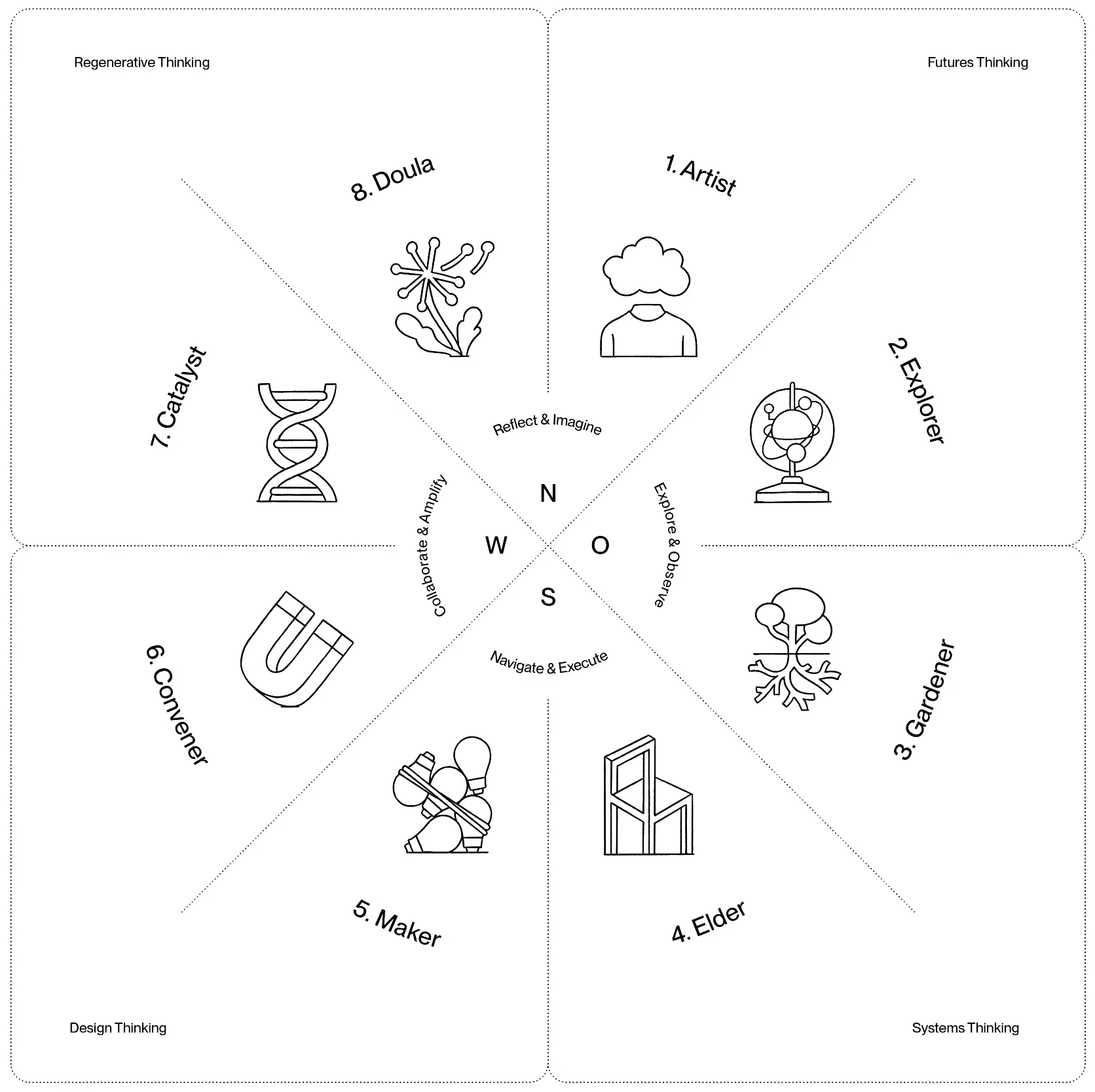
West
The West represents autumn, the season of harvest and abundance. In this phase, we gather together to share the fruits of our labor and celebrate what we’ve accomplished.
South
The South represents summer, a time of busyness, focus, and hard work. In this phase, we harness our sense of focus in order to fully develop the projects we’re working on.
East
The East represents spring, the season of fresh possibilities and excited beginnings. In this phase, we turn inspiration and ideas into plans, in order to activate and motivate ourselves and others.
North
The North represents winter, a time of dormancy, rest, and transition. In this phase, we reflect upon and integrate our learnings in order to prepare for what comes next.
Changing systems in practice
Once direction exists, it meets the system as it is. And systems do not change through plans alone.
Change moves through people. Through habits, incentives, power dynamics, and daily decisions. This work is iterative, relational, and often messy.
Leading change means shaping conditions where teams can learn, adapt, and move together. Progress grows when systems support how people actually work.
Get a sense of how your system works. Start your assessment →
Imagining future direction
How we imagine the future fuels the future we create. It begins when familiar ways of working start to lose their grip.
In complex times, leaders don't need answers; they need direction. A shared sense of seeing what no longer holds and where new paths might open.
Imagination is human work, not a machine task. It helps teams make sense of uncertainty and choose direction before solutions exist. This is where new futures begin.
Get a clearer sense of how you lead change: Start your assessment →
Colofon
The strategic and creative development of WITHIN and The 8 Crafts Field Guide to Responsible Innovation was initiated by co-founders Franklin de Bekker and Patrick Leenheers. We were supported by a group of inspiring thought leaders and creatives.
- Art direction & identity: Bas Koopmans (Wellness)
- UX: Maarten van Sprang and Franklin de Bekker
- Digital design & no-code development: Rick Bossenbroek (Uncode)
- Illustrations: Lennart Kok
- Photography: Elmer Driessen
- Editorial copy: Christina Williams (Liminal-stories)
- Editorial images: Marcel C. de Vries (Studio Superaarde)
- General support: members of The Collective
- Overall concept & strategy: Franklin de Bekker and Patrick Leenheers (WITHIN)
Join the Agentic Changemaker, Cohort 3
Thanks for your interest in the Agentic Changemaker program: Leading Change in the Age of Intelligence.
Cohort 3 starts with an in-person day on Friday 20 November at the Shell Energy Transition Campus Amsterdam, followed by four online sessions in November and December. Seats are limited, so we keep the group small.
Share a few details below, this helps us understand your context and get back to you about your spot.

Download Guide

Co-Intelligence is the Future
You’re about to join the waiting list for The 8 Crafts Braintrust - a space for those who shape the future by testing ideas, exchanging insights, and learning in practice.
What to expect:
- Braintrust Circles: Monthly peer-led sessions to exchange insights, test ideas, and share real-world applications.
- Field Guide Tools & Practices: Proven frameworks, templates, and methodologies from the 8 Crafts for practical implementation.
- Themed Chats & Meetups: Ongoing discussions and live gatherings around emerging practices and shared challenges.
🚀 Spots are limited, secure yours now.
Michelle Martin
I’m fascinated by human behavior and the systems that shape it. I love working where ideas turn into action, bringing clarity and structure to initiatives that matter. Over the past years, I’ve managed learning programs for global companies, designed onboarding and career pathways, and supported people and teams through organizational change.
As a dancer and yogi, I’ve learned to move with presence and intention, bringing that lens into every aspect of my life. I’m Certified as an Associate Project Manager (CAPM) and as a SHRM-CP, but what I really bring is a balance of structure and fluidity.
Learning, curiosity, and exploration are core values of mine, and my academic path reflects that. I studied Global Cultural Studies (BA), exploring how language, art, identity, and religion shape human experiences across cultures. I followed that with a Master’s in Political Economy of Development, diving into how political and economic systems influence development trajectories, and then a Master of Science in Work and Organizational Psychology to deepen my understanding of what drives people, teams, and organizations to thrive.
Having lived in the Dominican Republic, the US, Spain, and now the Netherlands, I’ve learned how to actively listen and build trust across cultures. I value autonomy and connection, balance and authenticity.
Michell Zappa
Grant Davidson
With a background in Design, Grant has been at the forefront of design thinking for the last 20 years. He has been an executive leader at Philips ensuring that this corporation could boast world class competences in Design, Marketing, and Innovation, providing leadership to large teams, and ensuring the most fertile conditions for people to develop themselves, and to achieve the best performance for their company. Grant excels in‘out-of-the-box’ thinking
“I have never felt so resolute and energised in my life . . . seeing the present state of climate change, social imparity, wealth imbalance and resource depletion, I am determined to do everything in my power to restore some semblance of dignity for humanity on this wonderful planet.”
“Through developing regenerative practices, and using dynamic systemic frameworks, I endeavor to amplify the movement of regeneration, and accelerate the eco awakening of influential leaders who share an inner unease in the face of the evident planetary crises, and are maybe already experiencing a heart-felt, even visceral calling to step up, to explore beyond the edge of present human comfort, and be catalysts of the repair, restoration, and regeneration of human presence, livelihood, and impact on Earth.”
Christina Williams
I am passionate about stories and the way in which they shape our realities. I believe modern marketing has gone astray and lacks authenticity. I want to redesign communications for more beautiful futures.
I enjoy collaborating with dreamers, visionaries, creatives, and changemakers to help bring far-fetched or seemingly unrealistic ideas to life. The world is in urgent need of new stories. I'm here to work with people and organisations who are telling those stories and help refine and amplify their message.
I'm a proud generalist and wearer of many hats. My expertise lies in combining big-picture thinking with attention to detail and logistical practicalities to bring all manner of things to life.
I currently live in Amsterdam with my husband and my dog. I find joy in long, quiet walks, cooking elaborate meals, and camping in the forest.
Sacha van Tongeren
In my professional life I always try to be an intermediate between social economic beliefs and creative powers. Sustainable development with a clear public value focus is what I believe in.
Over the past two decades I have built a track record of strategic partnerships and programmes that transcend borders, based on concepts that challenge the status quo and support change. Often in an international context, always at the intersection of arts/culture, technology and society.
The digital social innovation agenda has been an inspiring directive fueling my work. Based at Waag Future Lab I served the foundation of the European Social Innovation Competition and committed to the Social Innovation Exchange (SIX) network. With the exceptional team I developed several European research projects and created the steppingstones for social enterprise Fairphone. More recently I developed a multistakeholder innovation program for the Amsterdam Public Library, paving the way for a vision on the library of the future. In my work I find it essential to harness the knowledge and experience of people closest to the issue.
As I grew up spending most of my time sailing the Dutch waters and the North Sea, I became a wave-expert, always trying to make sense of the patterns in the water. This instilled in me an awareness of the voices unheard and the invisible forces that influence and drive us.
Challenges are many, but from experience I know the wisdom, creativity and experience within society are abundant as well.
Ola Lugowska
I am a breathwork expert with over thirty years of experience in holistic well-being, including in the corporate world. As an Advanced Buteyko Expert, Breathwork Coach, BreathMastery Facilitator, and certified Meditation and Yoga Teacher, I blend neurophysiological science with ancient practices. During my tenure at McKinsey & Company, I was a wellness ambassador, introducing restorative practices that fostered lasting habits and facilitated transformational changes in individuals and workplace cultures.
I specialize in integrating breath regulation into leadership development programs. Breath regulation helps leaders purposefully change their state of mind - their emotions and their thoughts - which improves their effectiveness and adaptability. It can help enhance essential leadership qualities such as empathy, presence, connection, creativity and self-transcendence.
Breathing is a tool. It is the connection of body and mind, of conscious and subconscious, between ideas and results. Mastery enables leaders to be responsive and conscious, benefiting themselves, their teams, and their organizations.
Ana Cardoso
In recent years, I've been curiously observing and experiencing the incredible potential for change, reinvention, and transformation that we have as human beings. This became my passion, my profession, and my area of study. I honed my practice as the global head of agile transformation at Kraft-Heinz.
I am currently invested in Transformative Coaching, which explores a person’s inner world of beliefs, assumptions, values and aspirations, in order to create greater possibilities for life and business.
I split my time between Europe and South America, learning from the best of both worlds.
I believe that overcoming outdated practices in business and innovation requires a strong network of visionary minds, hands and hearts, and this is the power of the WITHIN Collective.
Valentine Giraud
I started my work as a facilitator in leadership development at ABN AMRO Banco Real in Brazil in 2005. Since then I have dedicated my career to supporting individuals and groups to be in alignment with their purpose and to launch transformative ideas into the world.
I have helped teams create innovative processes and products, amongst them Pepsico, Nivea, Visa, Pernod, Banco Itau, Bauducco. I have also curated learning journeys for C-level executives in innovation hubs around the world, including Israel, China, Singapore and Silicon Valley. I have worked as a facilitator for THNK School of Leadership since 2016, leading programs in Brazil that supported not-for-profit and government leaders. Over the last two years, I have dedicated myself to a masters degree on the Psychology of Creativity in Santa Barbara, California.
My biggest passion is to meet people and discover places. I was born and raised in Brazil, and throughout my life I have lived in India, Holland, Canada and the United States. I am currently based in the south of France, from where I work and study remotely while enjoying the vibrant and inspiring culture of the region. I speak five languages and love a good adventure.
Robert Wolfe
Leading groups on a journey of personal discovery and creation is still my passion, even though I’ve been doing it for over 25 years. I can’t get enough, it seems!
I recently bought land in the mountains of Slovenia and my partner and I have built a home there, with chickens, cats and dogs. Beauty and peace are important to me.
I am good at creating a sense of safety and a sense of adventure at the same time.
Charlie Downing
I grow brands - and the people who lead them - by defining what they do, why they do it, who they serve, where they’re going, and how they show up in the world. I’m most energized by brands that put purpose ahead of profit.
My wife and I left expat city life for an Australian coastal town, where we live with our three young daughters. Balancing work with stillness, both from nature and community, keeps me smiling.
I learned that chasing perfection is a trap. Life’s much more interesting in the present, as a work in progress. Never done exploring, creating, learning from mistakes, and having fun along the way.
I help WITHIN by rallying leaders behind a company’s purpose to deepen the meaning they find in their work and accelerate their motivation for business to do good.
Laura Taal
Over the past 15+ years, I have worked on sustainability in commercial contexts. At PwC I advised organizations such as Philips and VROM on incorporating human rights into their procurement practices. At HEINEKEN I professionalized their global sustainable procurement programmes, and at IDH I collaborated with companies like Nestlé, Unilever and Mars on creating shared value in supply chains with smallholder farmers in the global South.
Today I bring individuals in touch with their vision on a sustainable future and guide them in bringing that vision to life in their personal and professional lives.
I am a pragmatic optimist with an atypical profile combining a social academic background with work experience in corporate as well as non-profit environments.
I live with my husband, daughter and son in Amsterdam. My personal vision is that we achieve global equity on a healthy planet by 2050.
Sacha Muller
I am a strategist and policy advocate with a strong belief in innovation and the power of technology for good. In my 20+ years in the business world and political arena, I have been at the helm, advising, coaching, and campaigning. My work spans sectors from retail to insurance, recreation to consumer goods, primarily supporting SMEs and scale-ups, as well as social entrepreneurs and the (semi-)public sector. My focus is on digitalization, innovation, and sustainability, all aimed at creating a future full of possibilities.
I live on a houseboat in Amsterdam, the Netherlands, with my husband and our two energetic and enthusiastic children who have a penchant for challenging my assumptions on a daily basis.
I love life, adventures and new discoveries – whether out in the world or in stillness, within. I enjoy sitting back and reading up on history, psychology, politics or innovation, or going out there to curiously engage with a myriad of ideas and possibilities. The richness lies in the balance.
Huib Wurfbain
It may seem I have two professions: investment and coaching. But they really are one and the same.
I started my career in banking and continued into capital markets, investor relations and M&A. Very financial guy you might think, but in all honesty it wasn't the numbers that piqued my interest. It always was about the story and the person behind the story. There is strategy, and there is leadership. It is the person that makes the difference.
Today, I combine being an angel investor in the energy and circularity space with leadership development, using all the tools and experience from my previous positions. I love it and intend to continue doing it for many years to come.
I am a husband to Niels and we live happily on one of Amsterdam’s most beautiful canals. You may spot me walking with my Welsh terriers, sometimes accompanied by a founder or a coachee. Listening and talking is best done while walking, I think. I am a singer: both individually and as part of a very fun choir. I am on a few boards, mostly related to impact. The board of Pride Amsterdam would be one of my most visible initiatives.
Lifelong learning is second nature to me. I love learning about new stuff, old stuff, the world around me and most importantly myself. I'd say that I have an inquisitive mindset and a willingness to try and experience new things.
Irene Rompa
I studied psychology, and then my first job after graduating was to expand a Dutch sustainability startup into the United States. I transferred to San Francisco and got immersed in the local innovation and tech scene.
When I returned to the Netherlands, the Dutch startup scene had just begun to gain traction. For the past 15 years, I’ve had all kinds of roles within the Dutch and American startup ecosystem; from being an entrepreneur myself, to leading accelerators, sustainability campaigns, managing public-private partnerships and organizing large innovation events.
Two years ago, I changed the direction of my career and returned to my two passions: hosting and psychology. I now work as a mediator, family constellations facilitator and host of many events. Since moving back from the U.S., Amsterdam has been my homebase. I enjoy the city for long walks, the cinema and a workout in Vondelpark.
With 15+ years of experience in the Dutch and American (deep)tech scene, I’ve seen a great number of companies from the inside while working in various positions myself. What drives me in all my roles is trying to really ‘see’ people. The skills that I need and use during mediation and constellations are similar to those I use while hosting a large event: listening, summarizing, making people comfortable and creating an atmosphere that brings out the best in others.
Patrick Leenheers
I am a long-time practitioner of innovation in the corporate context. I spent 22 years in telecommunications working on strategy, product and customer experience. Throughout my career, the common thread has been working on programs that required intense cross-functional collaboration. In 2012, I began working at THNK School of Leadership. I supported hundreds of leaders on innovation projects across sectors (maritime, energy, finance, pharma, health, tech, retail) and continents (Europe, Americas, Africa and Asia).
I practice performing arts including storytelling, cabaret and music. And I am a father of two young adult sons. I live in the Netherlands, not far from Amsterdam.
I never get tired of deepening my understanding of humans and life. Whether it is through ancient wisdom traditions, physics, psychology, economics, history, technology, or through poetry, music, art, nature and silence. Every layer adds understanding, and everything inspires me.
Franklin de Bekker
I spent the first 15 years of my career working in creativity and innovation in various positions in the creative industry. I combine multiple design disciplines with brand strategy. I am quick to embrace new technologies and cultural shifts, and I always keep an eye on what is on the horizon.
In 2018, I reached a pivotal fork in the road and discovered that leadership development is one of the most powerful levers for driving change. Since then, I have immersed myself in personal and organizational development, supporting teams and individuals in their leadership and innovation journeys.
These days, I chart a course into the future from my home in Amsterdam, where I live with my son, my partner, and our soon-to-arrive second child. I indulge in improv theater as a way to stay flexible and creative when life throws curveballs.
What drives me is making complex things simple and beautiful so that others can learn and be inspired to take action. I am obsessively curious and learn from everything I do. Marcel Proust was right: “The real voyage of discovery consists not in seeking new landscapes but in having new eyes.”.
I am worried about the future that my children will inherit. I sometimes get frustrated by the lack of long-term thinking and imagination, as well as the reliance on a ‘business as usual’ mentality. It is from that ‘divine discontent,’ that WITHIN was born, co-initiated with Patrick and a group of early supporters.

Introduction
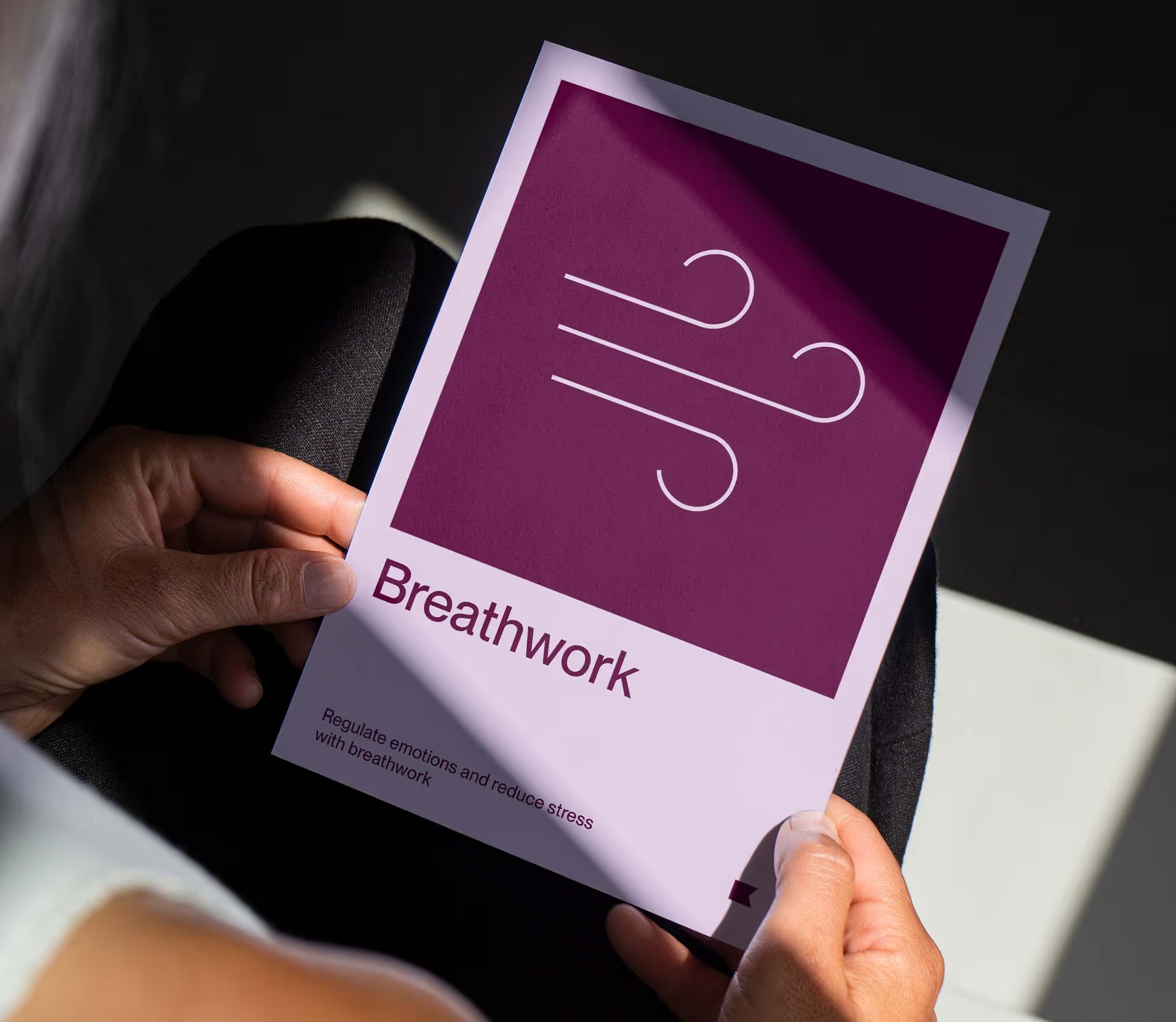
Conscious breathing is a practical way to support nervous system regulation.
The breath is closely connected with our inner state. When we are under pressure or agitated, our breath can become faster, shallower or less steady. When we bring attention to the breath and practice breathing in a quieter and more deliberate way, we can support nervous system regulation through the body. This practice is not about forcing calm. It is about noticing what is happening and using the breath to move to an inner state of peace and presence.
For leaders, this matters because our inner state affects how we listen, speak and respond. A tense or rushed state can make it harder to stay focused and listen deeply to what is happening. Agitation narrows our perception, reduces our problem-solving ability and distorts our connection to others. A more peaceful inner state makes it easier to pause, notice and choose more helpful responses.
Breathing is an accessible and immediately effective tool for nervous system regulation. It supports presence, emotional easing and recovery after pressure. It can be the foundational switch between our reactive state and our connected state, shifting our leadership from anxiety-based control to creativity, trust and collaboration.
When to use this practice
When we're stressed or anxious, we become reactive, controlling, protective. Our breathing becomes shallow and rapid. Conversely, slow, deep breathing activates the parasympathetic nervous system. This gives us acces to higher cognitive abilities: connection, creativity, openness and resilience.
Breathing regulation can support you when you need to:
- Regulate your state: Strong emotions can affect breathing, posture, attention and behaviour. Working with the breath can help you slow the process down enough to notice what is happening. It may not remove the emotion, and it does not need to. The aim is to relate to the emotion with more steadiness.
- Calm your nervous system: This does not mean becoming overly relaxed. A regulated state is alert and focused. Regulation means that you have more capacity to stay with what is happening, rather than being pulled into reaction.
- Regain presence: When pressure rises, attention can move quickly into planning, analysing or anticipating what might happen next. Bringing attention back to breathing can help reconnect you with the body. This can be useful when you need to listen, speak carefully or stay with a conversation that feels difficult.
- Slow down: Stress and urgency often affect the pace of breathing. Taking time to breathe through the nose, soften unnecessary tension and lengthen the exhale can help you return to a more workable pace. This is useful when speed is starting to reduce the quality of your thinking or your communication.
How to develop this practice
There are many forms of breathwork. Some practices are active and intense. Others are quiet and gentle. The practices below are intended to be simple, accessible and suitable for ordinary working life.
Stay within comfort. None of these practices should create strain, dizziness or distress. If a practice makes you feel worse, stop and return to normal breathing. If you have a respiratory condition, cardiovascular condition, panic symptoms, pregnancy-related concerns or any medical uncertainty, seek appropriate professional guidance before using breath holds or structured breathing practices.
Buteyko Breathing
The Buteyko Method was developed by Dr. Konstantin Buteyko. It focuses on nasal breathing, reduced breathing and gentle breath holds.
The aim is not to hold the breath for as long as possible. The aim is to breathe quietly through the nose and use short, comfortable pauses after the exhale.
How to practice
This is one of the Buteyko breathing exercises. It is called Short Breath Holds. Sit upright on the floor or on a chair. Let your spine be long but not rigid. Allow the shoulders, jaw and belly to soften.
- Breathe normally through the nose for a few moments
- Exhale normally through the nose.
- At the end of the exhale, gently pinch the nose for 1 second.
- Release the nose and breathe in gently through the nose.
- At the end of the next exhale, gently pinch the nose again for 1 second.
- Repeat this cycle for 1 minute.
- After 1 minute, stop the breath holds.
- Breathe in and out through the nose without trying to change anything. Let the breath settle for 1 minute.
Continue in this pattern for 10 to 15 minutes. Keep the breath nasal, quiet and comfortable throughout. Do not push through discomfort. Do not turn this into a long breath-holding exercise. The pause should feel easy.
Benefits
This practice encourages nasal breathing and a quieter breathing pattern. The short pause after exhalation can help you notice the natural rhythm of the breath. It can also help reduce the habit of breathing more than needed.
For many people, this practice is useful because it is simple and gentle. It can be used before a meeting, after a conversation or during a period of pressure.
Coherent Breathing
Coherent breathing involves slowing the breath to about 5-6 breaths per minute. This steady rhythm can support emotional regulation and help bring attention back to the body.A common version is to inhale for 5.5 seconds and exhale for 5.5 seconds, without holding the breath between the inhale and the exhale.
How to practice
Sit comfortably. Breathe through the nose if that is available to you. Inhale gently for about 5.5 seconds. Exhale gently for about 5.5 seconds. Continue for a few minutes.
You can use a timer or a breath pacing app. Some apps use sound, colour or movement on the screen to guide the rhythm. The breath should remain comfortable. If 5.5 seconds feels too long, shorten the count. It is better to practice with ease than to force a pattern.
Benefits
Coherent breathing gives the breath a steady rhythm. This can help bring attention back to the body and reduce the feeling of being rushed.The regular pace can also make the practice easier to follow. This is useful when the mind is busy or when it is difficult to focus.
Box Breathing
Used by Navy SEALs for stress management, box breathing is a simple yet effective technique for emotional regulation. A common version uses a count of four.
How to practice
- Inhale for ±4 seconds
- Hold for ±4 seconds
- Exhale for ±4 seconds
- Hold for ±4 seconds
- Repeat
Keep the breath easy. The holds should not create strain. If the equal count creates tension, shorten the count or choose another practice. Some people find box breathing steadying. Other people find the breath holds uncomfortable. If the holds create discomfort or tension, it is better not to continue. Tension works against the purpose of the practice
Benefits
Box breathing can help focus attention because it gives the mind a clear structure to follow. It can be useful before a demanding task, a high pressure situation or when you need a simple practice that does not require any equipment. It is not the right practice if the holds create strain. In that case, use a slower breathing practice without holds.
Diaphragmatic Breathing
Diaphragmatic breathing is sometimes called belly breathing. It helps bring awareness to the movement of the diaphragm during breathing.
Many people notice that stress changes where they feel the breath. The breath may feel higher in the chest, faster or more effortful. This practice helps you notice the movement of the breath lower in the body.
How to practice
This exercise can be done sitting upright, but laying down is a great way to start if you’re new to the practice.
- Lie on your back on a flat surface, such as a yoga mat.
- Bend your knees and support your head if needed.
- Place one hand on your upper chest.
- Place the other hand on your belly, just below the rib cage.
- Breathe in slowly through the nose, let the belly move outward as you inhale.
- Keep the upper chest as motionless and quiet as possible.
- Exhale through the nose, let the belly move back down as you exhale.
Continue for a few minutes. Do not force the belly to move. Let the movement be easy, allowing yourself to 'be breathed'. If lying down is not practical, you can also practice sitting upright.
Benefits
This practice helps you become more aware of how you are breathing. It can be useful when the breath feels high, tight or effortful. It can also help you slow down and return attention to the body. With regular practice, many people become better at noticing changes in their breathing earlier. This can make it easier to respond before tension builds further.
While it often requires conscious practice to bring our breath back down into our diaphragm, a great benefit of this form of breathing is that, over time, it becomes our ‘new normal.’ Some long-term benefits of diaphragmatic breathing include:
- Reducing cortisol levels, the stress hormone;
- Increasing oxygenation, potentially improving mood;
- Activating the relaxation response.
Benefits of this practice
Incorporate conscious breathing into your personal or professional routine to:
- Improve resilience: A primary benefit of conscious breathing is emotional regulation. By practicing regularly, you become more effective at dealing with intense, difficult, or stressful situations.
- Enhance leadership: Breathing supports nervous system regulation, which in turn helps you to show up as a more stable and resilient leader for your team. This can help strengthen the bonds within your team as your colleagues feel more supported.
- Increase presence: Breathing brings you back into your body, which results in increased mindfulness and awareness in complex situations.
How to take this further
To effectively use breathing for processing difficult emotions:
- Choose a technique: Select one breathing method that feels simple and manageable.
- Practice regularly: Repetition helps the practice become more familiar. It is easier to use under pressure when you have also practiced it in calmer moments.
- Combine with awareness: Notice the breath, the body and the pace of your thoughts. Pay attention to what changes as you breathe, and what does not change.
- Grow emotional literacy: Become aware of your feelings without trying to judge or change them. Notice where they live in your body, without naming them.
- Seek professional guidance: If difficult emotions are persistent or overwhelming, consider working with an appropriately qualified professional.
Breathing offers a powerful, accessible tool for managing and processing difficult emotions. By incorporating these scientifically-backed techniques into our daily lives, we can develop greater emotional resilience and well-being.
While it can be can be useful, it should complement, not replace, medical care or mental health support when needed.

See the
bigger picture
Every story, tool and practice fits into a larger method. Step back and observe how they connect, and why they help you lead change with confidence.